
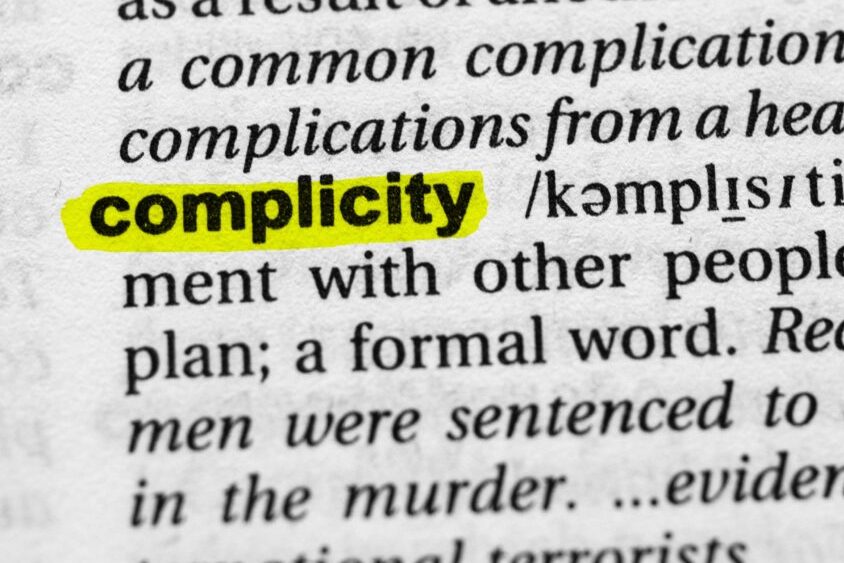
In a world where the elite and authorities hold all power and create all legislation the line between being compliant and complicit can blur, intertwine, and become one, hence the term ‘compliance complicity’. To be compliant is to adhere to any laws or regulations set by an authoritative power, and to be complicit is to take part in activities that are wrongful or illegal. Compliance becomes complicity when individuals or organizations conform to or permit the implementation of laws and regulations set forth by governing powers even when such laws are morally wrong, unethical, or infringe upon human rights. Moreover when policies in a compliance program are not actively enforced. It is crucial to understand when compliance develops into complicity to guarantee that organizations, bodies of authority, and individuals adhere to a standard that is just and ethical.
Being compliant to the law does not automatically make one complicit. Laws and regulations are mostly put in place to ensure that a population acts with principle and righteousness, however, there are instances in history and the modern day that display laws that are not morally sound or honorable. For example the system of Apartheid in South Africa during the 20th Century. Apartheid was a lawful governing system of oppression and discrimination that implemented countless laws that segregated people of colour from white people. Laws such as the Separate Amenities Act, the Pass Laws, and the Bantu Education Act were used to humiliate, dehumanize, segregate, and oppress people of colour in South Africa. White people were deemed superior and received social, economic, and political benefits during this time, and instead of fighting a blatantly racist and oppressive system many, if not most white people chose to be compliant with these laws and reap the benefits of being white. Being compliant with this system of prejudice, allowed the government to keep implementing more racist legislation and consequently, keep the cycle of poverty and oppression turning for over fifty years, excluding the hundreds of years South Africa was under cruel colonial rule. Consequently, complying with the government and its laws transformed into complicity as these laws marginalized millions of people and resulted in the deaths of thousands in the struggle for freedom, as well as stripped more than three-fourths of the population of human rights such as freedom of speech, right to education, the right to proper healthcare and so much more. Therefore compliance becomes complicity when one chooses to be passive and allows others to be subjected to violence, discrimination, or any immoral acts
Complicit silence is also a scenario in which being complaint transitions into complicity. When one turns a blind eye to unethical or illegal actions and takes no steps to prevent such situations is complicit. Being a bystander is deeming the wrongful and illegal action as right. Such as when an organization or company is conducting illegal activity behind closed doors and a person working there does not speak up and report it for fear of being laid off from their work. As well as overlooking any corruption or fraudulent activity authorities take part in, it brings no gain to those other than the people you are carrying it out. It is illegal and wrongful and is therefore an example of when compliancy becomes complicity. Choosing to stay silent permits the illegal actions of the company and it will continue to enact such immoral activity until it is brought to light. When an organization engages in illegal or unethical activities, employees who choose not to report these actions due to compliance with confidentiality agreements or other regulations could be seen as complicit. For this reason, choosing to be compliant and silent in the face of illegal such as fraud, bribery, and embezzlement is being complicit
A complaint program is a set of policies or regulations put in place by a company to ensure that the company works ethically and legally. However, when these policies are not a true reflection of the company’s actual practices, it leads to complicity. Such as false advertising, a few companies like to display and boast their environmentally friendly product or services, they depict their product as ethically produced and not harmful to the natural environment. However, they do not hold to these statements as what they are producing is made with damaging materials, they may be using environmentally harmful materials, creating significant carbon or water waste, or resorting to unethical labor practices such as child labour or unpaid labour. These actions directly contradict the ethical and moral guidelines, set in a compliance program In reality, this compliance program is not moral, it is complicity since the actions committed by the company are harmful and illegal. This illustrates how a compliance program may transition from being a guideline that encourages ethical standards to one of complicity when such policies and regulations are not consistently upheld.
While there are clear instances when compliance becomes complicity there are some situations that can be argued that to comply does not mean one is being complicit. Such as intent, the intent of a person can help one distinguish the line between complying and being complicit. Say a person complies with a set of rules with the intent of being an honorable, by-the-book employee or citizen. As well as if a person does not know the underlying unethical implications, someone such as this may not be held as responsible as others who are aware of the unlawful acts being committed. Another example where it could be argued whether a person intends to be complicit is when there are legal or physical repercussions. In some cases in history such as Nazi Germany, people had no choice but to comply and become indoctrinated by propaganda, it was either one who followed the regime or they were imprisoned or sent to the concentration camps. Out of fear for their lives, people followed the Nazis and their war crimes. A not-so-extreme example of being scared of repercussions would be to be fired from one’s place of work. Such work could be a person’s only source of income and losing it would be detrimental to their standard of living, therefore they comply with any regulations to make sure to uphold their position. However, even if one is scared of punishment or reprocussions it is, nevertheless, wrongful and unethical to allow such illegal or morally wrong activities to continue. This is why one must have the moral courage to stand up for what is right and to bring change for a better future.
Therefore, being compliant in some cases is complicity, such as choosing to abide by unjust laws, ignoring corrupt or unethical actions, not putting a compliance program into action, or being a bystander to immoral or discriminatory activity. For that reason, one must find moral courage and encourage whistleblowing in order to bring about a better future where laws and regulations are fair and just.
 NextGenPolitics
Leave a comment